The night before the Chubu Coast to Coast Twistybutt in October, I got a current comparison between the over half-century-old Tomei and the noticeably newer Shin-Tomei on a 220km run west to Iwata. It brought home how much better the newer, gently meandering Shin-Tomei is and how good it would be if the whole way from Kanto west were that smooth and free-flowing. Also started thinking about when they both came to be, why I couldn’t ride the whole Kanagawa to Shizuoka leg yet and when it would be completed. Short answer, 2027.
When, Why and How?
The Shin-Tomei Expressway’s design and planning began with a vision to connect Ebina Minami JCT in Kanagawa to Toyota Higashi JCT in Aichi, forging a 253 km masterpiece of smooth curves, wide lanes, and state-of-the-art facilities.
The first leg opened in 2012 and as of September 2025, 90% of this critical artery, approximately 228 km, is open in all its smooth rolling higher-speed glory!

Since 1969, the original Tomei Expressway has been the backbone linking the Kanto and Chubu regions via the coastal route. A highway hero that never rests. Unfortunately, sections of it can slow to a crawl during peak traffic congestion or construction, and although advanced for 50+ years ago, it is showing chronic deformation from the decades of pounding. It’s growing maintenance often causes traffic on it, too. Fortunately, the Shin-Tomei Expressway was conceived as an essential relief valve to the aging Tomei Expressway, a modern complement built for speed, safety, and capacity.
The Critical Gap and the Slipping Deadline
Despite the progress already made, a vital 25 km gap remains, holding its full-potential hostage. This uncompleted section, Shin-Hadano IC to Shin-Gotemba IC, forces us onto the old Tomei, specifically the tighter winding and accident prone segment between Isehara JCT and Gotemba JCT. This is where your patience is typically tested. Additionally, the section from Oi-Matsuda IC to Gotemba IC is notorious for being one of the most congested expressway segments on average in the nation. Data from 2019 shows that north-eastbound traffic on the Gotemba-Oi-Matsuda segment alone accounted for the 6th worst expressway bottleneck nationwide at the time.
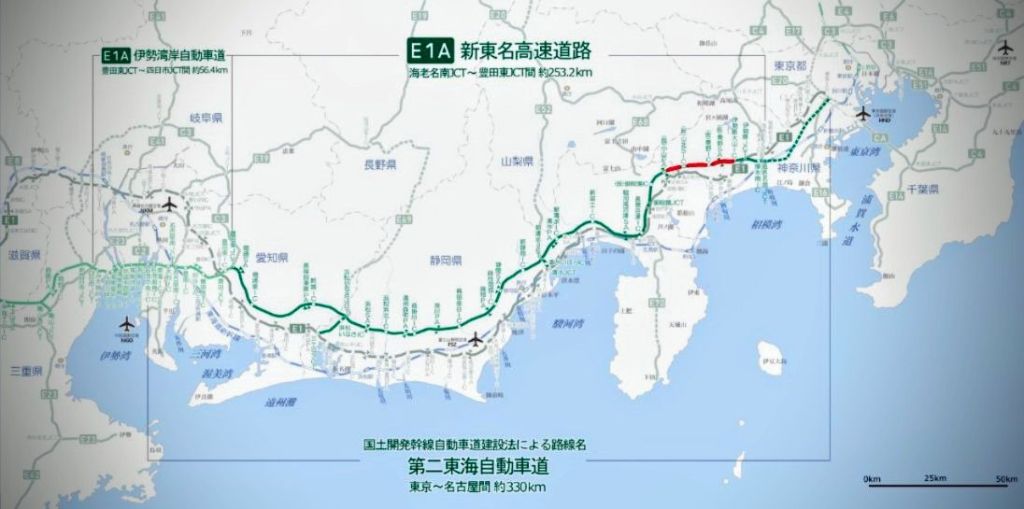
Despite the benefits and obvious necessity, it is taking its sweet time to completion. The reason for the seemingly snail-like construction and myriad of delays isn’t a lack of will, it’s simply a geological nightmare. This 25 km stretch has been the most difficult area for construction yet on both the Tomei and Shin-Tomei corridors and they decided to tunnel right through it rather than add another tight winding surface-level submission to the mountains, like we see on the current Tomei Expressway.
The greatest single challenge is the Takamatsu Tunnel, a 2.9 km bore through unforgiving mountains. Engineers discovered that the geological formations contain tuff, a material known to collapse and expand dangerously when exposed to water, rendering conventional tunnel boring techniques risky. With high levels of arsenic and random ground-water courses also adding to the caution!
Further compounding the issue, construction revealed an undisclosed fault zone that was missed in preliminary geological surveys. This demanded a shift to excruciatingly careful, low-risk construction methods.
So how’s all that affected its completion? The opening, initially pegged for 2020, was first revised to 2023 in 2019, and then, at the end of 2022, was officially pushed back to 2027. This delay of course means the initial ¥4.4 trillion estimate was very optimistic. As expensive as it’s going to be though, it seems to be a necessary consequence of prioritizing safety and structural integrity.
Current Progress and The Final Push
NEXCO Central Japan is balancing the yearn for completion with its non-negotiable policy of safety first. As of November 2024, progress metrics were as follows:
- Land acquisition virtually complete at 99%.
- Bridge construction at 70%.
- Tunnel construction (despite the endless issues) was 79% complete.
- Crucially, earthworks, the cutting and filling required for the roadbed in the mountainous regions, was only 49% finished.
That remaining 51% of earthwork, alongside the uncertainty surrounding the complex bridge and tunnel sections, is why the focus remains squarely on the completion of the Takamatsu Tunnel. The full opening is now scheduled for fiscal 2027 (as of October 2025). - On the plus side, All work on the Shizuoka side has been completed and even asphalt capped roads are evident.
Great step by step visual update here: https://youtu.be/dx5tgda0v9c?si=s1X4jvx9LWrw8Tkv
What Makes It Better?
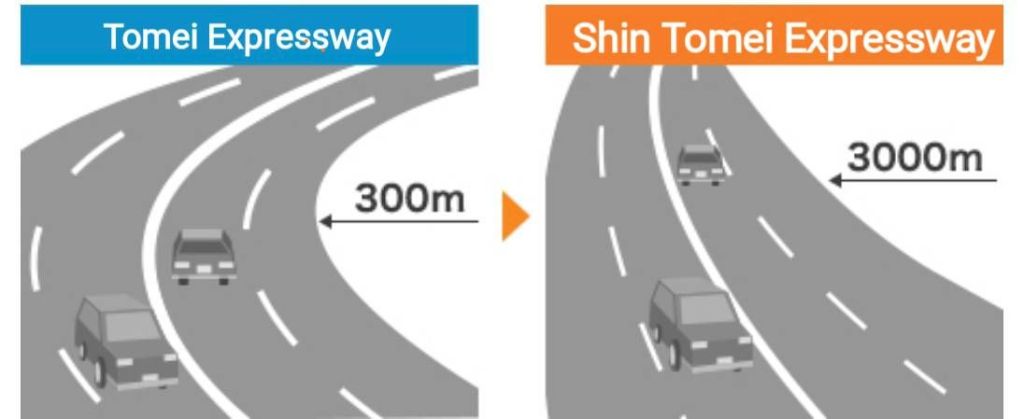
When designing the Shin-Tomei back in the 1990s, the Autobahn was a benchmark along with a belief that speed limits would increase dramatically with new vehicle and safety technology. While the original Tomei Expressway’s design brief allowed for curves as tight as 300m radius. The Shin Tomei’s bends have a minimum radius of 3000m.
The inclines and declines have also been reduced from 5% to 2% to reduce the accordion effect on traffic of heavy hauling vehicles over undulating roads.
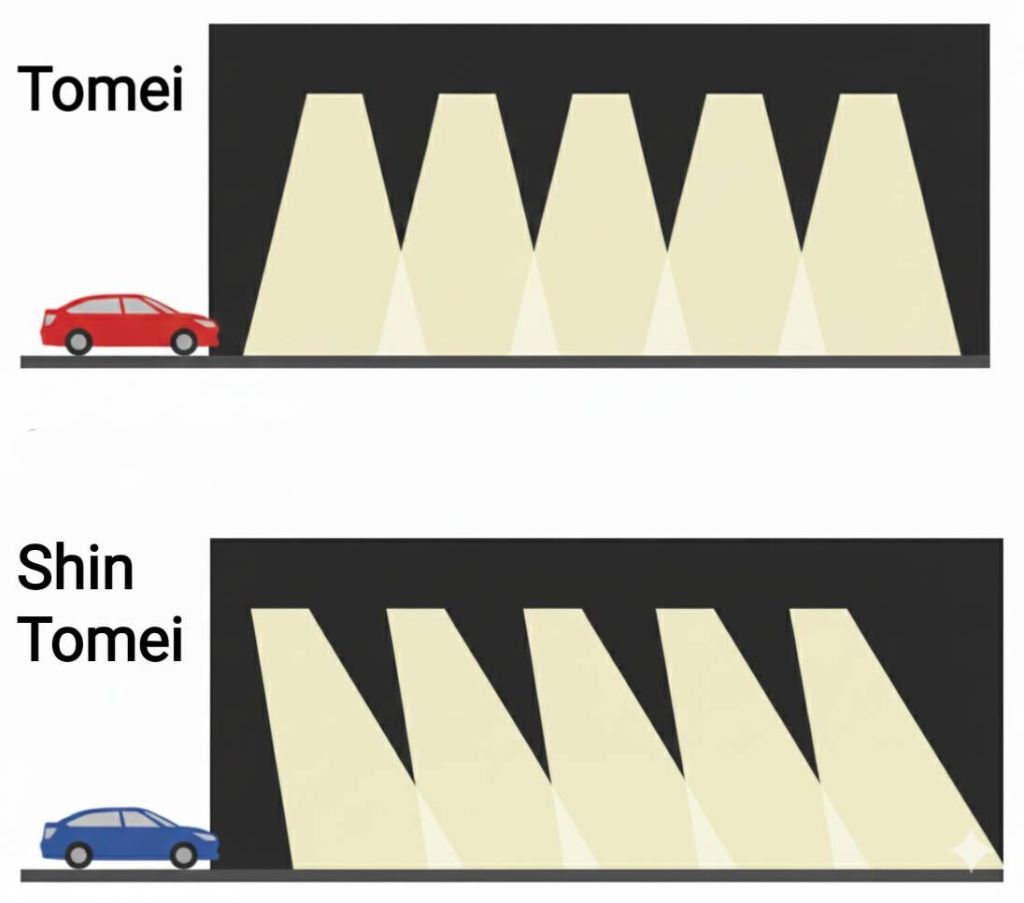
New LED pro-beam lighting on the Shin-Tomei Expressway focuses light ahead, reducing glare while improving visibility of cars ahead and promoting safer following distances, especially inside tunnels.
Then there’s the composition of the roadbed itself. With a focus on disaster damage mitigation in the earthworks construction stage, it’s built to resist movement, fatigue related damage and ultimately minimise maintenance and closures.
On top of its sturdy eathworks rests a 26-28cm slab of continuously reinforced concrete (CRC) as the structural layer. Then, the first softish layer, a 20cm granular base layer provides foundational support. On top of that, a 4cm layer of stone mastic asphalt (SMA) acts as a waterproofing membrane. Finally, where the rubber meets the road, it’s capped with 4cm of porous asphalt that provides a low noise and vibration surface for that smooth rolling comfortable ride we all feel while barreling down it the already opened section of the Shin-Tomei to the west.
How will the Shin-Tomei Benefit Bikers?
Right, let’s get back to that pre-Twistybutt night run to Iwata. Coincidentally, there was construction between Oi-Matsuda and Gotemba, closing the ‘Right-route’. Yes, the twistier one. Being a night run, butt feel was heightened so every bump, crack, lump or gap was obvious. Also, the trucks were out doing their rolling roadblock snail-like overtaking, constipating traffic flow. Fortunately, there weren’t too many vehicles, but some filtering was employed and the construction restrictions showed how quickly bottlenecks clog up flow.
Most glaring was the switch from the Shin-Tomei to the Tomei at Shimizu Junction. I’d taken Google Maps’ shortest route down with a very smooth transition between Shin-Shimizu and Shimizu Junctions. But once on the 55+ year old Tomei, it went from feeling like a billiard ball rolling effortlessly across the felt to riding dips and bumps with jarringly uneven sections of road. I was soon wishing I’d stayed on the 120km/h Shin-Tomei to Hamamatsu-Hamakita IC, avoiding that 80-odd kilometers of spinal bungy-bronco and 80km/h limit. That old Tomei is really showing its wear.
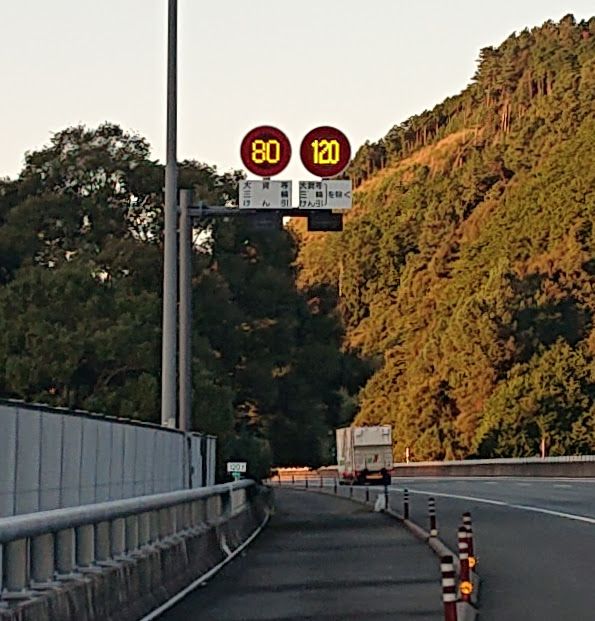
This last bit of the run was tiring, frustrating and not something I’m looking forward to doing again. And there’s the rub. For most of us, expressways are a necessary tool to get us to and from the fun roads, hidden gems and grand personal adventures our bikes take us on. The supremely more modern Shin-Tomei gets us there and cossets us on the return leg so much better. So, that missing 25km is keeping 40km of oldskool expressway in the mix. But, the billiard ball smooth runs out n back aren’t that far away. Hang in there!
Resource Credits
Summery of Regression Analysis | Download Table https://share.google/nBEhWyC2kMlNjMw2Z
Expressway Construction Information – NEXCO Central Japan https://share.google/AtKFnVCcmXWSMBl6W
 Touge Express